
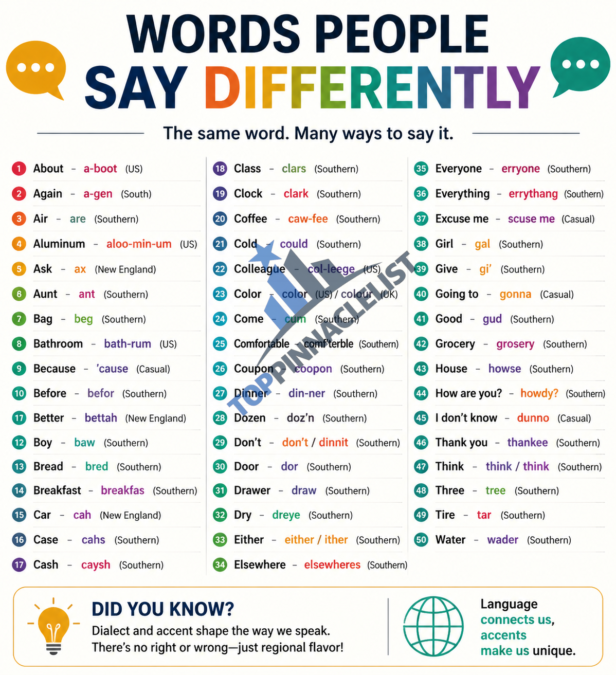

Have you ever wondered why some words sound completely different depending on where you are? Language isn’t just a set of rules—it’s a living, breathing reflection of culture, history, and regional identity. For instance, someone in New York might say “tomato” slightly differently than someone in Georgia, and a person from London will often pronounce “garage” in a way that surprises Americans. Understanding these variations is not only fun—it can prevent awkward miscommunications, especially in travel, business, or social situations.
In this article, we’ll explore words people say differently, covering examples from the US, the UK, and other English-speaking regions. We’ll highlight common patterns, funny variations, and some controversial pronunciations that spark debates online. By the end, you’ll have a deeper understanding of how regional accents, historical influences, and social context shape the way words sound, giving you practical insight into both casual and formal communication.
Why Words Sound Different
Language evolves naturally over time. Words are influenced by:
- Regional accents – Southern American English often stretches vowels, while Boston English can drop the r entirely.
- Historical migration – Settlers, immigrants, and traders brought their own pronunciations, leaving lasting imprints.
- Social identity – People sometimes pronounce words a certain way to signal belonging to a community or social group.
- Media and pop culture – Television, radio, and online content standardize some pronunciations while introducing new slang.
Even a simple word like “route” can be pronounced as root in some areas or rout in others, depending on local convention.
Common Words People Say Differently in the US
The United States alone has thousands of regional accents, making pronunciation highly variable. Some examples include:
- Caramel – CAR-mel vs. CARE-a-mel
- Pecan – PEE-can vs. puh-KAHN
- Soda/Pop/Coke – What you call a soft drink depends entirely on your region.
- Bagel – Slight vowel differences make New Yorkers’ bagels sound distinct.
- Water – Wah-ter vs. Wo-der (the classic New York vs. Midwest pronunciation)
Interestingly, many Americans don’t realize these variations exist until they hear someone from another state.
Words People Say Differently in the UK
Across England, Scotland, Wales, and Northern Ireland, pronunciation changes dramatically:
- Schedule – SKED-jool vs. SHED-yool
- Aluminium – al-you-MIN-i-um (UK) vs. al-uh-MIN-um (US)
- Bath – Short a in northern England, long ah in southern England
- Tomato – to-MAH-to (UK) vs. to-MAY-to (US)
Even within London, Cockney accents add drops and glottal stops, making the same word sound almost unrecognizable to outsiders.
Funny Words People Say Differently
Language variations can be amusing, and some words spark playful debates:
- Envelope – AHN-velope vs. EN-velope
- Caramel – People argue for both pronunciations fiercely.
- Data – DAY-ta vs. DAH-ta
- Vase – Vahz vs. Vays
These differences often cause harmless confusion in social situations, but they also highlight the rich diversity of spoken English.
Words People Say Differently in the South
Southern American English has its own charm and uniqueness:
- Y’all – Contraction of you all, now used widely beyond the South.
- Fried – Vowels may stretch in words like pie (pah-ee).
- Oil – Pronounced closer to all in some regions.
- Pen – Often sounds like pin in certain southern accents.
These variations can make Southern English sound musical or draw laughter, but they’re deeply tied to identity and community.
Controversial Words People Say Differently
Some pronunciations spark passionate debates online:
- Gif – Jif vs. Gif
- Meme – Short vs. long vowel debates
- Niche – Neesh vs. Nitch
- Route – Root vs. Rout
What’s interesting is that even linguists disagree sometimes—meaning pronunciation isn’t about right or wrong, but about convention, context, and cultural acceptance.
Tips for Understanding Regional Variations
- Listen actively – Pay attention when people speak; context often helps.
- Ask politely – “Do you pronounce it…?” can clear confusion.
- Avoid judgment – Variations don’t indicate intelligence—they reflect culture.
- Adapt when needed – If communicating professionally, match the local norm.
- Have fun – Learning different pronunciations can enrich your language skills.
Real-Life Examples
- A tourist in Boston orders a “Wah-ter” and gets a confused look; adapting to “water” solves it instantly.
- A UK executive in the US says “schedule” the British way; some American colleagues initially misunderstand but appreciate the explanation.
- Online debates about GIF pronunciation show how digital communication spreads regional differences globally.
FAQ: Words People Say Differently
Q1: What are words people say differently across America?
A1: Words like pecan, caramel, water, and route vary widely depending on state or city. Accent and historical influences shape these pronunciations.
Q2: How do accents affect words people say differently?
A2: Accents alter vowel length, consonant use, and rhythm. Southern, Boston, and Midwestern accents are classic examples in the US.
Q3: Are there funny words people say differently?
A3: Yes, words like envelope, vase, and caramel often lead to playful debates or amusing misunderstandings.
Q4: Why do some words have controversial pronunciations?
A4: Words like GIF or niche spark debates because regional usage and personal habits clash, and online communities amplify these differences.
Q5: How can I understand words said differently in the UK vs. US?
A5: Exposure is key. Listening to regional media, podcasts, or talking to locals helps you pick up pronunciation nuances quickly.
Conclusion
Words aren’t static—they change across regions, cultures, and communities. From pecan to aluminium, understanding words people say differently helps prevent miscommunication and deepens appreciation for the richness of English. Embrace these variations, listen actively, and enjoy the playful diversity of language. Whether traveling, working, or chatting online, knowing the subtle differences can make you sound more aware, approachable, and culturally sensitive. Language is as much about connection as it is about correctness—so the next time someone pronounces tomato differently, smile and learn.