
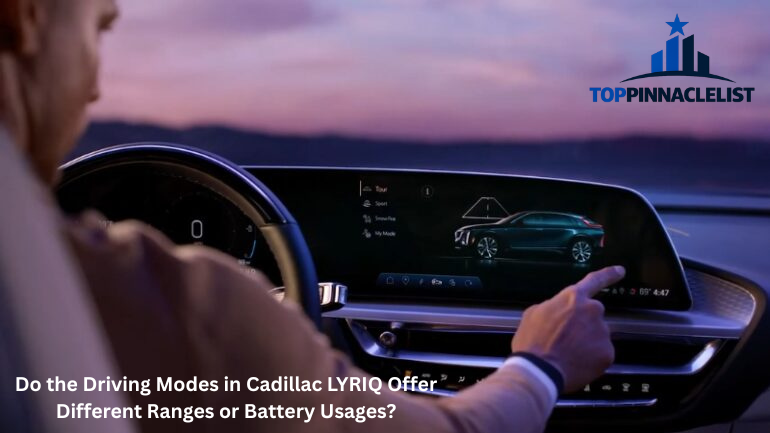

If you’re considering or already driving a Cadillac LYRIQ, you’ve probably wondered whether the different driving modes actually change how far the vehicle can go on a single charge. The question do the driving modes in Cadillac LYRIQ offer different ranges or battery usages? is more important than it seems, especially if you’re trying to maximize efficiency for daily commuting or long-distance trips.
Many EV drivers assume driving modes only change acceleration feel or steering weight, but in the LYRIQ, they can also influence energy consumption in subtle but meaningful ways. That means your choice between Touring, Sport, Snow/Ice, or My Mode can slightly affect how quickly your battery drains.
In this guide, we’ll break down how each driving mode works in real-world conditions, when range differences actually matter, and how you can use these settings strategically. You’ll also learn practical driving habits that have a bigger impact on battery life than mode selection alone.
How Cadillac LYRIQ Driving Modes Actually Work
The Cadillac LYRIQ is designed as a software-controlled electric SUV, meaning driving modes adjust multiple systems at once. These include:
- Throttle response (how quickly the car accelerates)
- Steering sensitivity
- Regenerative braking strength
- Climate control behavior (in some conditions)
- Power distribution to motors
While none of the modes directly “unlock” extra battery capacity, they influence how efficiently energy is used.
In simple terms:
- Some modes prioritize comfort and efficiency
- Others prioritize performance and responsiveness
That balance is where range differences appear.
Do Driving Modes Change Range in the Cadillac LYRIQ?
The short answer is: yes, but only indirectly.
The LYRIQ does not have separate battery sizes for each mode. Instead, driving modes change how aggressively energy is consumed.
Touring Mode (Most Efficient in Real Use)
Touring is typically the default mode and is tuned for balanced efficiency.
- Smooth acceleration
- Moderate regenerative braking
- Comfort-focused calibration
👉 Real-world effect:
This is usually the best mode for maximizing range, especially on highways and steady-speed driving.
Sport Mode (Highest Energy Usage)
Sport mode sharpens throttle response and increases performance feel.
- Faster acceleration
- Heavier steering
- More aggressive power delivery
👉 Real-world effect:
Energy consumption increases noticeably, especially in city driving where acceleration is frequent.
- Range reduction can occur in stop-and-go traffic
- Highway difference is smaller but still present
Snow/Ice Mode (Stability Over Efficiency)
This mode prioritizes traction and control.
- Softer throttle response
- Reduced wheel slip risk
- Adjusted power distribution
👉 Real-world effect:
Range may decrease slightly due to conservative power management, but the difference is usually minimal unless driving in harsh conditions.
My Mode (Custom Behavior)
My Mode lets drivers customize steering, braking, and acceleration feel.
👉 Real-world effect:
Range depends entirely on your settings:
- If tuned for performance → lower efficiency
- If tuned for comfort → similar to Touring
Why Range Differences Are Not as Big as You Think
One of the most misunderstood aspects of EVs like the LYRIQ is that driving modes don’t dramatically change total battery capacity usage.
Instead, the real factors are:
- Driving style (aggressive vs smooth acceleration)
- Speed consistency
- Climate control usage
- Terrain (hills vs flat roads)
👉 Unique insight: In controlled conditions, switching from Touring to Sport might change range by only 3–10%, but aggressive driving style alone can reduce range by 20–30%. This means your foot matters more than your mode.
Real-World Example: Same Route, Different Modes
Imagine a 50-mile daily commute:
Scenario 1: Touring Mode
- Smooth acceleration
- Steady highway cruising
- Light regen braking
➡️ Estimated consumption: baseline efficiency
Scenario 2: Sport Mode
- Frequent fast acceleration
- Higher power bursts in city traffic
- More braking energy loss
➡️ Battery usage increases noticeably over time
Scenario 3: Mixed Driving (Realistic Case)
Most drivers switch between modes unconsciously.
👉 Result:
- Differences become smaller than expected
- Driving behavior dominates efficiency
Regenerative Braking: The Hidden Factor
One overlooked system is regenerative braking, which recovers energy when slowing down.
Driving modes influence how strong or smooth regen feels:
- Touring: balanced regen recovery
- Sport: less aggressive regeneration feel
- Snow/Ice: controlled and cautious regen
👉 Unique insight: Many drivers lose range not because of mode choice, but because they don’t fully use regenerative braking in stop-and-go traffic. Learning to “one-pedal drive” efficiently can improve range more than switching modes.
Climate Control and Mode Interaction
Another subtle factor is how driving modes interact with climate systems.
- In Sport mode, higher power demand can slightly increase HVAC load indirectly
- In Touring mode, energy distribution is more balanced
- Cold weather reduces range regardless of mode
👉 Real-world observation: In winter, HVAC usage can reduce range far more than switching from Touring to Sport.
Practical Tips to Maximize Range in Any Mode
Instead of focusing only on driving modes, use these habits:
1. Smooth Acceleration
Avoid sudden throttle input whenever possible.
2. Maintain Steady Speeds
Highway consistency improves efficiency more than mode selection.
3. Use Regenerative Braking Effectively
Let the vehicle slow itself when approaching stops.
4. Precondition the Battery
Warm or cool the cabin while plugged in to reduce energy drain.
5. Choose Mode Based on Conditions
- Touring → daily driving
- Sport → short performance bursts
- Snow/Ice → weather safety
Common Misconceptions About LYRIQ Modes
Myth 1: Sport Mode “uses more battery no matter what”
Not exactly true. It only uses more energy when you drive aggressively.
Myth 2: Touring Mode always gives maximum range
It helps efficiency, but poor driving habits can still reduce range significantly.
Myth 3: Driving modes change battery size
They don’t. They only adjust how energy is used.
Advanced Insight: Software Calibration Matters More Than Modes
One less discussed detail is that Cadillac continuously updates energy management software. This means:
- Efficiency improvements can come via updates
- Regenerative behavior may evolve over time
- Mode behavior may subtly change with firmware upgrades
👉 Unique insight: Some owners report improved range consistency after software updates, even without changing driving habits. This shows that battery usage is partly shaped by evolving software logic, not just driving modes.
FAQ
Do driving modes in Cadillac LYRIQ significantly change range?
They can affect range slightly, mainly through driving behavior changes. Sport mode tends to use more energy, while Touring is the most efficient.
Which Cadillac LYRIQ mode gives the best range?
Touring mode usually provides the best balance for maximum range. It is designed for smooth and efficient driving.
Does Sport mode drain the battery faster?
Yes, but only if you drive aggressively. Gentle driving in Sport mode will not dramatically reduce range.
Is Snow/Ice mode less efficient?
It can be slightly less efficient due to conservative power management, but safety improvements outweigh the small energy difference.
What affects LYRIQ range more than driving modes?
Speed, acceleration habits, weather conditions, and climate control usage have a much larger impact than driving modes.
Conclusion
Driving modes in the Cadillac LYRIQ do influence battery usage, but not in the way many people assume. The difference between Touring, Sport, Snow/Ice, and My Mode is mainly about how power is delivered—not how much battery capacity you actually have.
In real-world driving, your habits matter far more than your selected mode. Smooth acceleration, steady speeds, and effective regenerative braking will always have the biggest impact on range.
The key takeaway is simple: use driving modes as tools for comfort and control, not as the primary method for maximizing range.